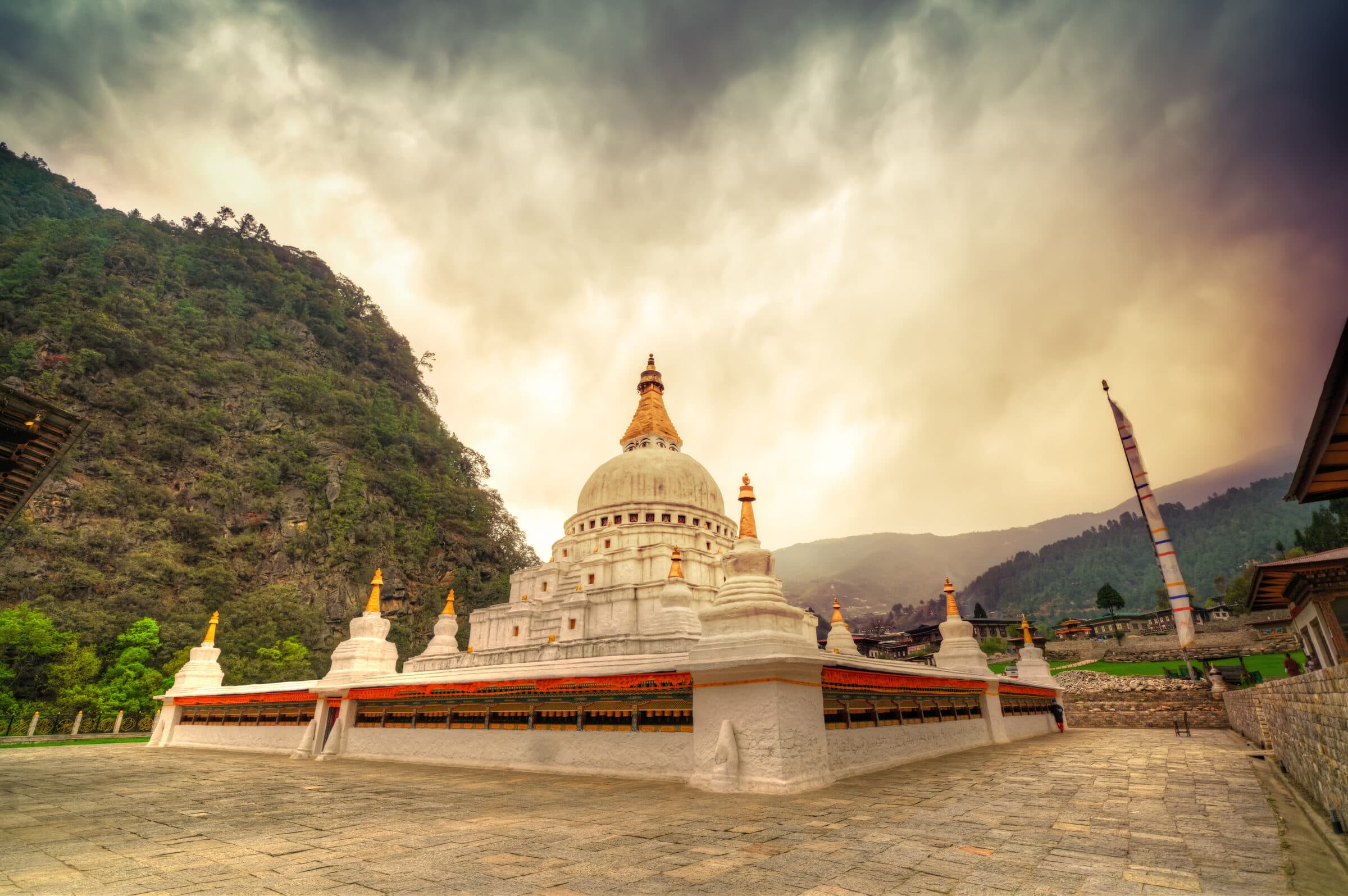
The altitude profile of Bhutan
**Paro Airport (PBH)** sits at **2,235 metres** — the visitor's first altitude exposure on arrival. **Thimphu** is at **2,300 metres**; **Punakha** is substantially lower at **1,200 metres** (warm, comfortable); **Phobjikha** sits at **3,000 metres** (cold, the principal high-altitude valley on the standard circuit). **[[paro-taktsang|Tiger's Nest]]** sits at **3,120 metres** — the principal day-hike altitude for most visitors. **Dochu La pass** is **3,100 metres** (a drive-through stop). The high-altitude treks reach progressively higher: [[druk-path-trek|Druk Path]] tops out at 4,200m; [[chomolhari-trek|Chomolhari]] at 4,900m; [[snowman-trek|Snowman]] at 5,320m. Altitude tolerance varies substantially by individual; prior altitude experience is the principal predictor of how well a visitor will adapt.
Acclimatisation principles
The standard altitude-medicine principles apply in Bhutan as elsewhere: **ascend slowly** (no more than 500-1,000 metres of sleeping altitude gain per day above 3,000m); **acclimatise at moderate altitude before going high** (a 2-3 night stay in Paro/Thimphu before any high-altitude trek); **stay hydrated** (3-4 litres per day at altitude); **avoid alcohol** for the first 48 hours at altitude; **eat carbohydrate-rich food** (the body works harder for energy at altitude). For Bhutan, **Day 1 at Paro is the acclimatisation day** — light walking in the valley, no high-elevation hike, early sleep. For visitors flying in from sea level, a 2-night Paro stay before the Tiger's Nest hike is the standard profile.
Symptoms to watch for
Mild acute mountain sickness (AMS) symptoms are common above 2,500 metres: **headache**, **mild nausea**, **sleep disruption**, **slight breathlessness on exertion**. These typically resolve within 24-48 hours as the body adjusts and don't preclude continuing the itinerary at a moderate pace. **Significant symptoms** — severe headache that doesn't respond to ibuprofen, persistent vomiting, breathlessness at rest, confusion, ataxia (loss of coordination), persistent dry cough — are signs of higher-grade AMS and require descent. Your guide carries a pulse oximeter and monitors the visitor's oxygen saturation throughout any high-altitude itinerary. Saturation below 85% at rest is a flag; below 80% is a descent indication.
Diamox and altitude medication
**Acetazolamide (Diamox)** is the standard altitude-prophylaxis medication. The protocol: 125-250 mg twice daily, starting 24 hours before significant altitude gain and continuing through the highest-altitude exposure. **For Bhutan alone, Diamox is optional** — most visitors complete Paro, Thimphu, Punakha, and Tiger's Nest without prophylactic medication. **For Phobjikha (3,000m+)**, Diamox is worth considering for visitors with prior altitude difficulty. **For any high-altitude trek above 4,000m, Diamox is recommended** — we discuss with the visitor and their physician before the trek. **Side effects** include tingling in fingers and lips (common, mild), increased urination (common), occasional altered taste of carbonated drinks. **Contraindications** include sulfa allergy and certain kidney conditions — consult your physician.
High-altitude trekking — the preparation
Trekkers planning [[druk-path-trek|Druk Path]] (max 4,200m), [[chomolhari-trek|Chomolhari]] (4,900m), [[chomolhari-laya-gasa-trek|Chomolhari-Laya-Gasa]] (5,005m), or [[snowman-trek|Snowman]] (5,320m) need substantial pre-trek altitude preparation. **Pre-trek acclimatisation profile**: 3 nights in Paro (2,200m), 1-2 days of moderate hiking in the Paro valley before the trek begins, sometimes a pre-trek night at the Bumthang lodges (2,600m). **The trek itself** includes built-in acclimatisation rest days (Day 3 at Jangothang for Chomolhari, Day 10 at Laya and Day 17 at Thanza for Snowman). **Our trek leaders carry pulse oximeters** and monitor the trekker's oxygen saturation each morning and evening; descent decisions are made on the basis of objective data rather than visitor stoicism. **Helicopter evacuation** is available from the high routes in clear weather; the cost (~USD 5,000-15,000 depending on location) is typically covered by trekking insurance.
How we adjust for individual altitude tolerance
Altitude tolerance varies substantially between individuals — prior altitude experience, age, fitness, hydration, and unrelated medical conditions all matter. Our concierge requests altitude-history information at the proposal stage (have you been above 3,000m before; did you experience any altitude difficulty; do you have any relevant medical conditions). Where there is reason to expect difficulty — first-time altitude exposure, prior altitude problems, age 70+, certain cardiopulmonary conditions — we adjust the itinerary's altitude profile (longer Paro acclimatisation, skip Phobjikha, choose lower-altitude lodge tiers) and discuss the adjustments with the visitor's physician where useful. **The cultural circuit is comfortable for almost every visitor with the right pacing**; we have hosted visitors in their 80s who completed Bhutan comfortably.