Preparing
LoadingPreparing
LoadingA Bhutanese strategic context
The Bhutan-India relationship is the foundational bilateral relationship of contemporary Bhutan — the 1949 Treaty of Friendship and the 2007 revision define the framework; India is by a wide margin Bhutan's principal trading partner, principal development partner, and principal security partner. The relationship operates on the principle of full sovereignty for Bhutan combined with deep practical integration — the Indian rupee circulates freely alongside the Bhutanese ngultrum at parity, the Bhutan-India hydropower partnership is the principal export-revenue engine, and the open Bhutan-India border (the country's only land border for non-Indian visitors) shapes the contemporary tourism register.
institution
In short
The Bhutan-India relationship is the foundational bilateral relationship of contemporary Bhutan. 1949 Treaty + 2007 revision. India is the principal trade, development, and security partner. Ngultrum at parity with the Indian rupee. The relationship combines full Bhutanese sovereignty with deep practical integration.
The Bhutan-India relationship is framed by the 1949 Treaty of Friendship, signed on 8 August 1949 between His Majesty the Second Druk Gyalpo Jigme Wangchuck and the newly-independent Government of India. The original treaty contained a clause through which India would 'guide' Bhutanese foreign policy — a clause that operated in practice as Bhutanese consultation with India on major external matters. The 2007 revision removed this clause and reframed the relationship on the basis of equal-sovereign cooperation — Bhutan retains full autonomy in its foreign policy while maintaining the deep economic and security partnership with India. The 2007 framework is what contemporary Bhutan-India relations operate within. See the 1949 Treaty event entry.
Hydropower is the principal Bhutan-India economic linkage. Bhutan's Himalayan river-valley topography supports substantial hydroelectric generation potential; multiple major projects (Chukha 336MW completed 1986-88, Kurichhu 60MW, Tala 1020MW, Punatsangchhu I & II, Mangdechhu) have been built principally with Indian government finance and technical partnership. The electricity is exported principally to India under long-term power-purchase agreements; hydropower exports are by a wide margin Bhutan's principal export-revenue source. Trade — India is the principal trading partner across most categories; the open border at Phuentsholing-Jaigaon and other crossing points supports substantial cross-border trade. Currency — the Bhutanese ngultrum is pegged at parity to the Indian rupee; the Indian rupee circulates freely in Bhutan alongside the ngultrum. The Bhutanese SDF rate for Indian visitors (Nu 1,200 per night) is set lower than the international SDF (USD 100) reflecting the special relationship.
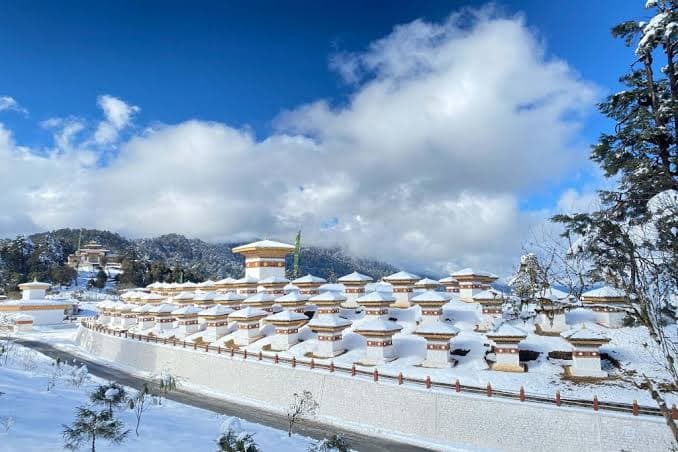
The Indian Military Training Team (IMTRAT) based in Haa is the principal Indian-military-training presence supporting the Royal Bhutan Army; the partnership has been continuous since the 1960s and provides training and equipment for the Bhutanese defence. The 2003 operation — the Royal Bhutan Army's removal of Indian-insurgent encampments in southern Bhutan (an operation His Majesty the Fourth Druk Gyalpo personally directed) was both a Bhutanese sovereignty assertion and an act of deep practical support for the Indian security interest; the 108 Druk Wangyel Chortens at Dochu La commemorate the operation. See the Dochu La entry. The northern border — Bhutan's northern boundary with Tibet (the People's Republic of China) is the unresolved border in the broader regional context; the Bhutan-India security partnership operates in the context of this northern boundary.
The contemporary Bhutan-India tradition operates at breadth across the economic, security, cultural, and diplomatic levels. State visits — His Majesty the Fifth Druk Gyalpo and the Indian Prime Minister maintain regular state-visit exchanges; regional cooperation operates on the principal economic and security matters. Development partnership — India provides substantial annual development assistance covering infrastructure, education, health, and broader development programmes; Indian-government contribution to Bhutanese development across the post-2008 democratic-constitutional era has been considerable. The contemporary tourism register — the open Bhutan-India border at Phuentsholing-Jaigaon, the principal road from India into Bhutan, and the Indian-visitor numbers (over 100,000 annually pre-COVID; over 47% of total 2025 visitor numbers) reflect the tourism-relationship dimension. The matched guide briefs international visitors on the contemporary partnership where relevant.
Common questions
No — Bhutan has been a fully sovereign country since the 1949 Treaty (and effectively since the 1907 Wangchuck dynasty founding); the 2007 Treaty revision removed any clause that could have been read as constraining Bhutanese sovereignty in foreign policy. Bhutan maintains independent foreign relations, sets its own domestic and international policies, and operates as a full member of the United Nations (since 1971), the South Asian Association for Regional Cooperation, and other international bodies. The substantial Bhutan-India practical partnership coexists with full Bhutanese sovereignty.
Indian citizens — yes, the open border at Phuentsholing-Jaigaon and other crossing points provides relatively low-friction access. The Bhutanese SDF for Indian visitors is Nu 1,200 per night (lower than the USD 100 international SDF). Non-Indian-passport-holders — no, you cannot use Indian land borders as a transit route into Bhutan; international visitors must fly into Paro on Drukair or Bhutan Airlines. See the Bhutan from Singapore guide for the typical international-visitor routing.
The Indian Military Training Team — the principal Indian-military training presence supporting the Royal Bhutan Army, based in Haa dzongkhag since the 1960s. The IMTRAT provides training and equipment to the Bhutanese defence; the partnership is one of the more notable bilateral military-cooperation relationships in South Asia. Visitors do not typically encounter the IMTRAT; the matched guide briefs on the broader Bhutan-India security context where relevant.
Related ideas
Theme
The Wangchuck dynasty — the hereditary monarchy of Bhutan since 17 December 1907. Five reigning monarchs across five generations. The contemporary state's institutional spine.
Theme
Bhutanese democracy — the constitutional monarchy, the 2008 transition, the National Assembly, the political party landscape. A distinctive Asian democracy.
Theme
Gross National Happiness — the Bhutanese development philosophy articulated by the Fourth Druk Gyalpo at His 1974 coronation as the first of nine guiding goals. Four pillars, nine measurement domains, constitutional grounding.
Journeys built around it
Journey
The signature-tier Bhutan journey. Private knowledgeable guide, the most considered lodges, helicopter or PC-24 charter, exclusive-use arrangements. By invitation, from USD 14,000.
Journey
A multigenerational Bhutan journey for Indian HNI families. Indian-national SDF rate, daily Drukair from DEL/CCU/BOM, Indian-fluent guide, signature-tier lodges.
Five questions. A bespoke draft back within a day or two.