Preparing
LoadingPreparing
Loading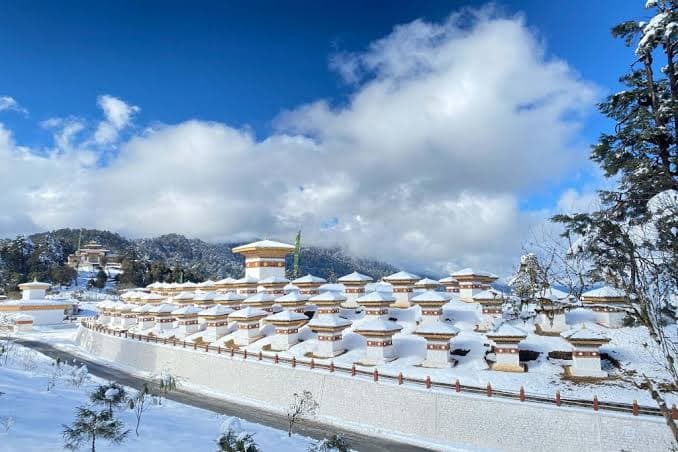
The 108-chorten pass at 3,100 metres
Dochu La sits at 3,100 metres on the road between Thimphu and Punakha — the principal mountain pass of the western Bhutanese drive. The pass is marked by 108 small chortens (the Druk Wangyel Chortens) built in 2003 under the patronage of Her Majesty the Queen Mother Ashi Dorji Wangmo Wangchuck, and on clear winter mornings the panorama of the eastern Himalaya — Masagang, Tsendagang, Gangkhar Puensum, Chomolhari — is among the most-photographed Himalayan vistas accessible by road.
Visiting
In 2003, Her Majesty the Queen Mother Ashi Dorji Wangmo Wangchuck commissioned the building of 108 chortens on the pass to commemorate the soldiers who died in the 2003 Royal Bhutan Army operation against Indian-insurgent encampments in southern Bhutan — an operation that the Royal Government conducted to remove a security threat to both Bhutan and India. The chortens are arranged in three tiers (the upper, middle, and lower courses) around the pass's principal viewpoint, with the central chorten the largest. The number 108 carries deep significance in the Buddhist tradition — the number of mala beads, the number of human afflictions to be subdued, the number of Songtsen Gampo's founding temples.
Beside the chortens stands the Druk Wangyel Lhakhang — a temple completed in 2008 in dedication to His Majesty the 4th King and his service to the country during the 2003 operation. The temple is unusual in being entirely modern in its iconography — the principal frescos include depictions of His Majesty the 4th King at the head of his troops, scenes from contemporary Bhutanese history including the 1907 founding of the Wangchuck dynasty, the 1953 first National Assembly, and the 2008 transition to constitutional democracy. The temple is the principal example of contemporary Bhutanese religious patronage and is open to international visitors with a guide.
On clear winter mornings (December through February typically gives the most reliable visibility, October through November in the autumn window also strong), the pass affords one of the most-photographed Himalayan vistas accessible by road. From left to right (west to east) the principal peaks visible are: Chomolhari (7,326 m), Jichu Drake (6,989 m), Masagang (7,158 m), Tsendagang (7,300 m), Tarigang (7,300 m), and (on exceptional days) Gangkhar Puensum (7,570 m, the highest peak in Bhutan and the highest unclimbed mountain in the world). The morning before 10 a.m. typically gives the clearest panorama; cloud builds across the day.
Common questions
Festivals held here
Festival
Punakha Drubchen & Tshechu — the late-winter festival pair at Punakha Dzong, with the Tibetan-invasion re-enactment. Dates, programme, what to expect.
Festival
Wangdue Tshechu — three days at the rebuilt Wangdue Phodrang Dzong. Dates, programme, what to expect as a visitor.
Journeys featuring this site
Journey
A private seven-night Bhutan honeymoon for couples flying from Singapore. Bhutanese lodges, a matched guide, transparent all-inclusive pricing.
Journey
A nine-night Bhutan photography journey in the spring window — cherry blossom, rhododendron, the Paro Tshechu thongdrel unfurling at dawn at Rinpung Dzong.
Journey
A six-night winter journey through Bhutan in January — clearest Himalayan visibility, Punakha's warm valley, fewer travellers, and lodges by the fire.
Also known as · Dochula · 108 Chortens Pass · Druk Wangyel Chortens
Five questions. A bespoke draft back within a day or two.