Preparing
LoadingPreparing
LoadingA Bhutanese institutional framework
Bhutan transitioned from absolute monarchy to constitutional monarchy with elected democratic government in 2008 — a deliberately structured transition initiated under His Majesty the Fourth Druk Gyalpo and completed under His Majesty the Fifth Druk Gyalpo. The constitutional framework preserves the cultural and religious institutional structure while establishing the elected National Assembly and National Council as the principal legislative bodies. One of the more distinctive constitutional democracies in Asia.
institution
In short
Bhutan is a constitutional monarchy with elected democratic government since 2008. The Constitution preserves cultural-religious framework; the National Assembly and National Council are the principal elected bodies. Initiated by His Majesty the Fourth Druk Gyalpo, completed by the Fifth.
Bhutan's constitutional democracy was the deliberate decade-long reform from 1998 to 2008. The Royal Government's secondary-school history records the principal moments: 1998 — His Majesty the Fourth Druk Gyalpo dissolved the existing Cabinet, appointed a new one drawn from elected and nominated representatives, and declared He would henceforth remain only as Head of State (no longer head of government). The Bhutanese history-textbook frames this as 'the beginning of the historic journey towards constitutional monarchy'. 2001 — His Majesty commanded the drafting of a new Constitution, with substantial public consultation across all 20 dzongkhags over the subsequent six years. 2006 — His Majesty voluntarily abdicated in favour of His son, enabling the new Constitution to be ratified under the new monarch. 2008 — the first democratic elections in March-April; the formal coronation of His Majesty the Fifth Druk Gyalpo on 6 November; the ratification of the Constitution coinciding with the centenary of the 1907 founding. The transition operated without internal political crisis, without civil unrest, without international intervention — among the most carefully executed democratic transitions in modern history. See the 1998 Head-of-State decision for the inflection point.
The 2008 Constitution establishes Bhutan as a constitutional monarchy with His Majesty the Druk Gyalpo as head of state and an elected democratic government. Key Articles: Article 3 — Buddhism as the spiritual heritage of Bhutan (not the state religion); Article 4 — protection of cultural traditions; Article 5 — minimum 60% forest cover in perpetuity; Article 9 — Gross National Happiness as the state's guiding development principle; Article 24 — Right to Information (citizen access to government information); Article 27 — His Majesty's mandatory abdication at age 65 in favour of the elder royal child, institutionalising the voluntary-abdication precedent. The Constitution is among the more distinctive in Asia — combining constitutional democracy with explicit cultural-religious and environmental commitments at the constitutional level.
The Bhutanese parliament has two chambers. The National Assembly (the lower house, Gyelyong Tshogdu) — 47 elected members, two-round electoral system, four-year terms; the principal legislative body responsible for new legislation, the annual budget, and the principal policy debates. The National Council (the upper house, Gyelyong Tshogde) — 25 members, 20 elected (one per dzongkhag) plus 5 royal appointees; non-partisan (members run independently rather than as party candidates), four-year terms; the review-and-oversight body for the National Assembly's work. The two-chamber framework was designed to balance the elected-political tradition (National Assembly) with the non-partisan dzongkhag-representative register (National Council).
Multiple registered political parties operate in Bhutan's constitutional democracy. The principal parties include the People's Democratic Party (PDP), Druk Phuensum Tshogpa (DPT), Druk Nyamrup Tshogpa (DNT), and Bhutan Tendrel Party (BTP). The landscape has evolved across the four electoral cycles since 2008 (elections in 2008, 2013, 2018, 2023). Voter turnout has remained substantial across cycles (typically 65-80%); the political tradition is generally civil and policy-focused rather than ideologically-polarised. For visitors, the political tradition is largely invisible — the country's political life operates within the constitutional framework without disrupting the cultural and tourism tradition that visitors encounter.
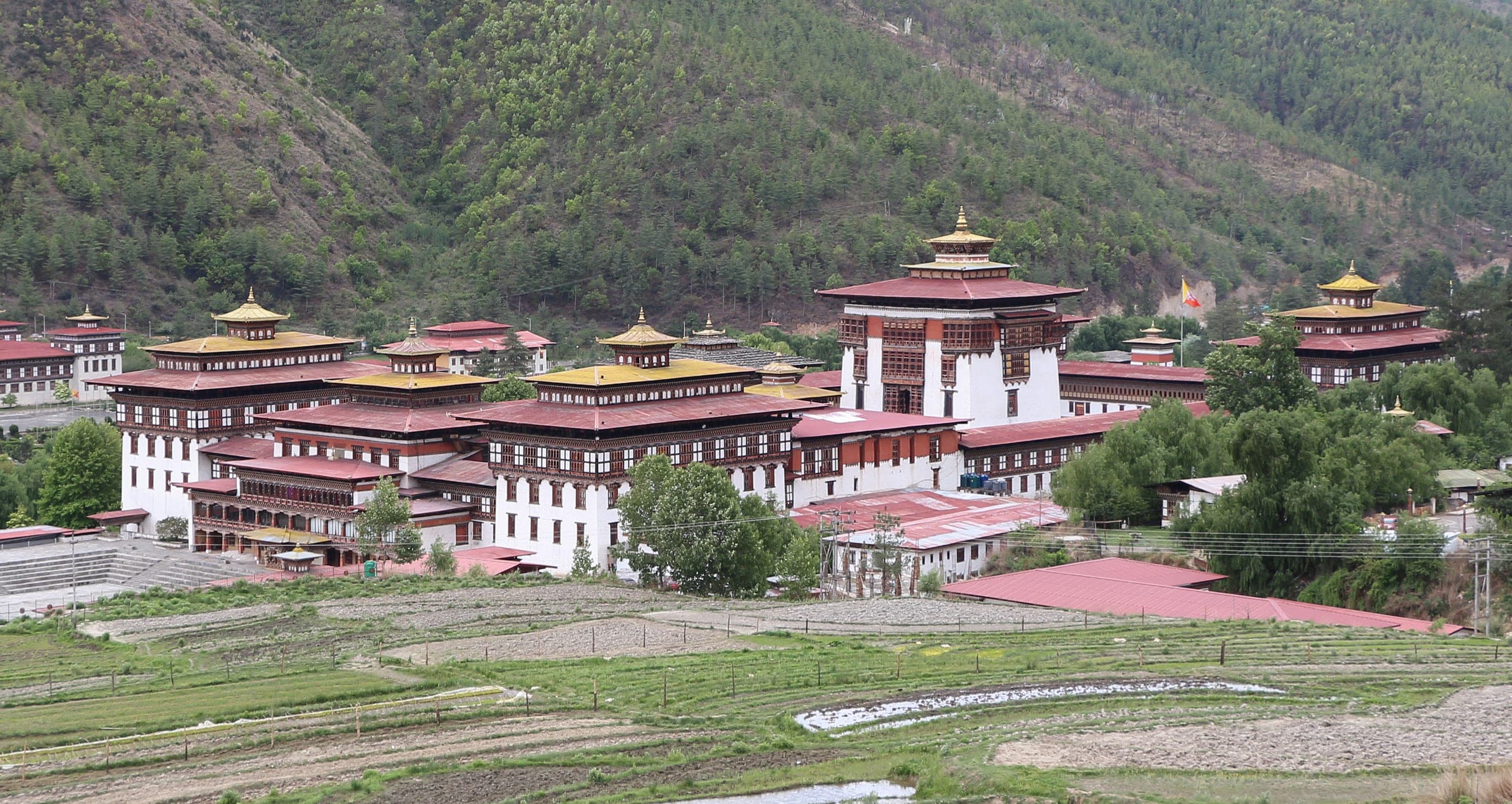
The contemporary Bhutan a visitor encounters is the country operating under the 2008 Constitution. The visa framework, the SDF rate, the tourism policy, the dzong-administration, the festival calendar are all the operational outputs of the constitutional democracy. The dzongs continue to host both the Royal Government administrative offices and the Zhung Dratshang religious institutions — the principal Choesi structural legacy still operating within the new constitutional framework. The matched guide is happy to discuss the constitutional framework with visitors interested in the institutional; most visitors encounter the democracy through its operational outputs rather than its political register.
Common questions
Yes — a constitutional monarchy with elected democratic government since 2008. Multiple political parties, two-chamber elected parliament, regular elections (2008, 2013, 2018, 2023), substantial voter turnout. His Majesty the Druk Gyalpo is head of state but operates within the constitutional framework; the elected government runs the policy. Among the more distinctive constitutional democracies in Asia.
Strategic foresight. His Majesty the Fourth Druk Gyalpo recognised that long-term Bhutanese state stability required the institutional framework of constitutional democracy — not dependent on the personal qualities of any specific monarch. The deliberate transition (2001 drafting, 2006 voluntary abdication, 2008 ratification and first elections) institutionalised the democratic governance while preserving the cultural and religious continuity.
No. Foreign citizens — including international visitors — have no political-participation rights in Bhutanese democracy. The political tradition is for Bhutanese citizens; international visitors encounter the democracy through its operational outputs (the visa, the SDF, the tourism framework, the cultural) rather than through political participation.
Related ideas
Theme
Gross National Happiness — the Bhutanese development philosophy articulated by the Fourth Druk Gyalpo at His 1974 coronation as the first of nine guiding goals. Four pillars, nine measurement domains, constitutional grounding.
Theme
Vajrayana Buddhism — the branch of Buddhism that shapes Bhutanese religious life. Drukpa Kagyu, Nyingma, Guru Rinpoche; mantra, mandala, deity yoga.
Five questions. A bespoke draft back within a day or two.