Preparing
LoadingPreparing
Loading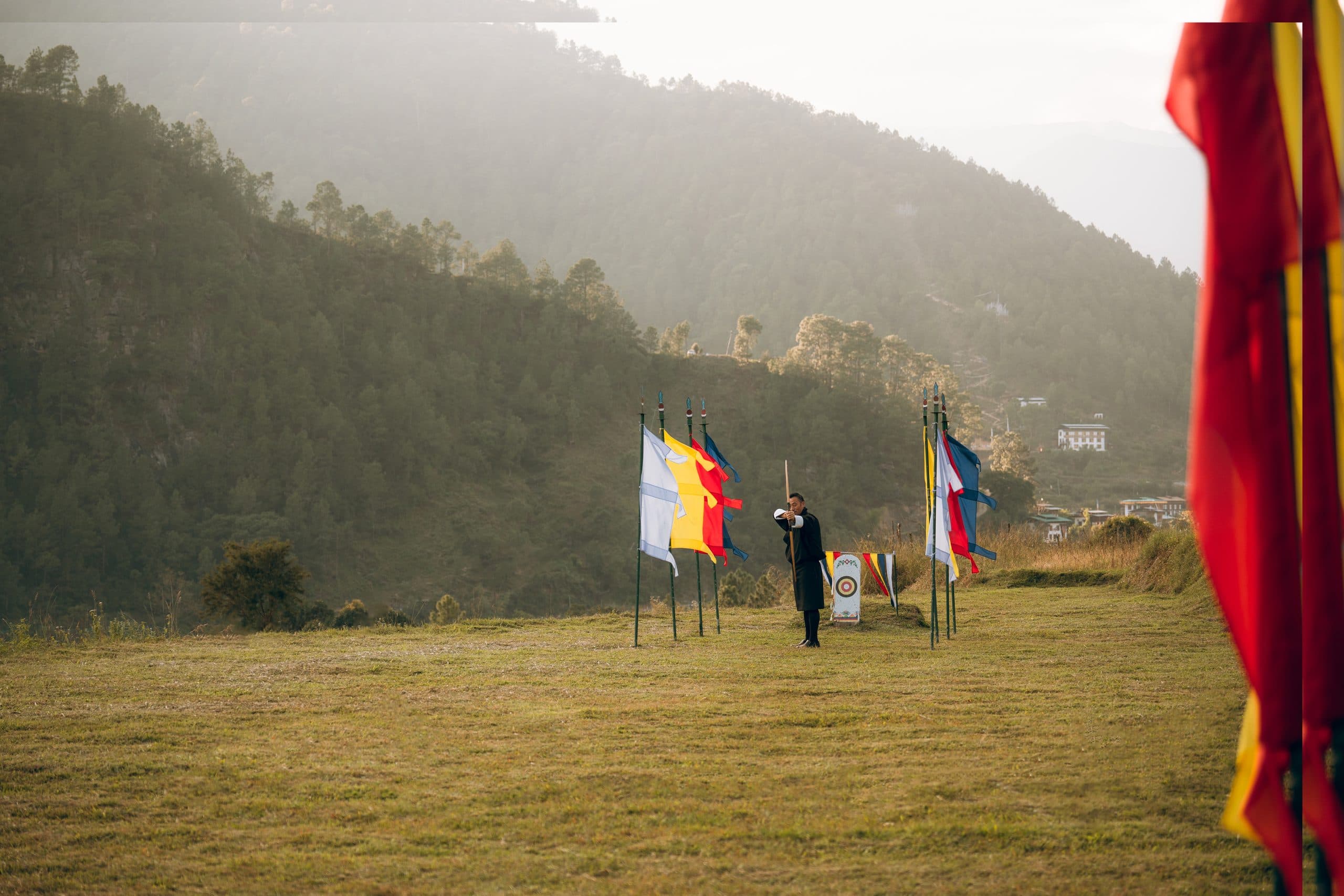
A Bhutanese experience
Bhutanese archery — da in Dzongkha — is the country's national sport, formally so designated in 1971. But the sport is older by some centuries than the formal designation: it is the principal game of Bhutanese village life, played on long afternoons in every dzongkhag, accompanied by song and dance, food and drink, the easy noise of a community at leisure. A visitor who watches a Bhutanese archery match watches something that is not, strictly, sport at all in the international sense — it is a form of public life in which the bow is the instrument.
sport · Changlimithang archery ground (Thimphu) or local archery clubs in any dzongkhag · half-day
Bhutanese archery is played in two teams. The target — a small wooden board, painted with a coloured bullseye — sits at 145 metres, far longer than any standard international archery distance. Typically eleven players per side, though local matches are flexible. The bow has two registers: traditional Bhutanese bamboo bows are still used at village matches and festival demonstrations; competitive archery in the capital is mostly played with modern high-tension compound bows imported from the United States. The mood is celebratory — archery in Bhutan is inseparable from singing, dancing, eating, drinking, and the gentle ritualised teasing of one's opponents. The sport was made the official national sport in 1971 when Bhutan joined the United Nations.
The two teams stand at opposite ends of a long field, with targets at each end. Archers shoot in turn — typically two arrows per archer per round — and the teams alternate ends as the day progresses. A direct hit on the target board is worth two points; a hit within an arm's length of the target counts for one. Matches are played to a set number of points (often 25 or 33) and can last most of a day. Between rounds, the team not shooting sings and dances in front of the target — the dance is partly celebration, partly the gentle psychological work of disrupting the opposing archer's concentration. The songs are often improvised; the exchange is good-humoured. When an archer hits the target, his teammates run forward in a brief dance of celebration, planting a coloured scarf in their ghos to mark the hit.
Traditional bamboo-bow archery is the older form. The bow is a single piece of bamboo, shaped and tensioned by hand; the arrows are wooden, fletched with eagle or hawk feathers. The draw weight is lower than a modern compound bow, and the trajectory of the arrow is high and arcing — a small white parabola against the sky, falling toward the target after a long flight. Bamboo archery is most often seen at village matches and at festival demonstrations. Modern compound-bow archery is the form most often seen at competitive matches in the capital and in district tournaments. The bows are high-precision compound bows of the kind used in international competition. The two registers coexist comfortably; some clubs play both, switching equipment by the match.
For an international visitor with a half-day in the capital, Thimphu's Changlimithang archery ground — adjacent to the historic battle-site of the same name — is the standard place to watch. Matches are played most weekends; the ground is open to spectators; the experience is informal and welcoming. For a deeper encounter, a visit during one of the major festivals — when archery competitions are commonly held as part of the festival programme — combines the sport with the broader festival context. The matched guide can usually arrange for a visitor to try a few shots at a club's practice ground, with a traditional bamboo bow if preferred; the experience of holding a Bhutanese bow at a target a hundred and forty-five metres distant gives one a particular respect for the archers who hit it. His Majesty the Fourth Druk Gyalpo is a strong patron of the sport and an accomplished archer himself; the royal interest has reinforced the sport's central place in public life.
Alongside archery, the second great traditional Bhutanese sporting tradition is khuru — a form of long-distance darts, played with heavy wooden darts thrown at a small target some twenty metres distant. Khuru is the village game played when there is no time or space for an archery match; the social tradition is the same — teams, singing, celebration on a good throw, the easy rhythm of a community at play. A visitor interested in Bhutanese sport should ask about both.
Practical
Common questions
The wider idea
Theme
Gross National Happiness — the Bhutanese development philosophy articulated by the Fourth Druk Gyalpo at His 1974 coronation as the first of nine guiding goals. Four pillars, nine measurement domains, constitutional grounding.
Theme
Vajrayana Buddhism — the branch of Buddhism that shapes Bhutanese religious life. Drukpa Kagyu, Nyingma, Guru Rinpoche; mantra, mandala, deity yoga.
Journeys that include it
Journey
The signature-tier Bhutan journey. Private knowledgeable guide, the most considered lodges, helicopter or PC-24 charter, exclusive-use arrangements. By invitation, from USD 14,000.
Journey
A nine-night Bhutan family trip from London for autumn half-term. Bhutan including Phobjikha; teenager-friendly light treks; matched knowledgeable guide.
Journey
A four-night Bhutan corporate retreat for senior teams of 6–12. Paro and Thimphu route, working sessions integrated, autumn clear-sky window.
Five questions. A bespoke draft back within a day or two.