Preparing
LoadingPreparing
Loading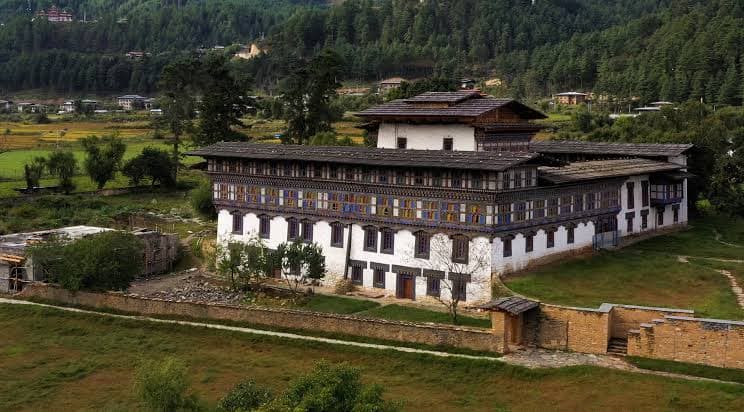
A Bhutanese royal palace
Wangduecholing Palace in the Chhume valley of Bumthang is the principal pre-monarchy royal residence of the Wangchuck-dynastic-line. Built in 1857 by Trongsa Poenlop Jigme Namgyel — the Black Regent and architect of united Bhutan — on the very battlefield where He had defeated Tsondrue Gyaltshen the same year, the palace was the birthplace of His Majesty the First Druk Gyalpo Ugyen Wangchuck (1862) and the principal residence of His Majesty the Second Druk Gyalpo Jigme Wangchuck across His twenty-six-year reign. The palace is the canonical physical anchor of the Wangchuck dynastic story.
Also known as · Wangdue Choeling Palace · Wangduechoeling Palace · Wangduechholing Palace
In 1857, Trongsa Poenlop Jigme Namgyel — by then the paramount political figure of central Bhutan — defeated his rival Tsondrue Gyaltshen at the Battle of Shamkhar below Jakar Dzong. On the battlefield itself, in the Chhume valley of Bumthang, He commissioned Wangduecholing Palace as His personal residence. The deliberate choice of the battlefield as the palace site carried the religious-political register intentionally: the building stood as a permanent commemoration of the consolidation moment. Five years later, in 1862, His son His Majesty Ugyen Wangchuck — the future First Druk Gyalpo — was born at Wangduecholing Palace. The palace would remain in the family across the subsequent five generations of the dynasty.
His Majesty the Second Druk Gyalpo Jigme Wangchuck (reigned 1926-1952) made Wangduecholing Palace His principal residence across His twenty-six-year reign. While the formal seat of government rotated between Punakha, Thimphu, and Bumthang across the period (the central administrative move to Thimphu would not be completed until His Majesty the Third Druk Gyalpo's reign in 1952), His Majesty operated from Wangduecholing as the personal residential anchor. The palace housed the early Bhutanese central monk body during the principal religious-events of the year; the Thinlay Rabten school — the second modern Bhutanese school, opened 1915 for the Crown Prince Jigme Wangchuck and his attendants — was attached to the palace and operated within its grounds.
In 1884, when His mother Ashi Pema Choeki died, His Majesty Ugyen Wangchuck bequeathed Wangduecholing Palace to His sister Yeshey Choeden and her husband Chhime Dorji (the son of Pema Tenzin) — a deliberate arrangement that consolidated the family-alliance network across the central Bhutanese region. The palace remained in the family across the subsequent decades and was, intermittently, an active royal residence into the 20th century. The contemporary register: Wangduecholing Palace operates today as a heritage site under careful conservation by the Department of Culture; the building structure, the original royal-family interiors, and the surrounding Chhume-valley estate are preserved as a national heritage asset. The Royal Heritage Museum at Trongsa Ta Dzong carries the principal interpretive materials for visitors who want the full pre-monarchy story.
Visiting
Common questions
Trongsa Poenlop Jigme Namgyel built the palace in 1857 on the Shamkhar battlefield, not His Majesty the Second Druk Gyalpo (a misattribution that occasionally appears in secondary sources). His Majesty the Second Druk Gyalpo Jigme Wangchuck inherited the palace through the family-line and made it His residential anchor across His twenty-six-year reign — but the construction itself was the work of His grandfather Trongsa Poenlop Jigme Namgyel four years before His Majesty Ugyen Wangchuck's birth.
No — the palace is now a heritage site under conservation by the Department of Culture rather than an active royal residence. The contemporary royal family resides principally at Dechencholing Palace north of Thimphu (built from 1952 onward by His Majesty the Third Druk Gyalpo); Wangduecholing carries the principal pre-1952 dynastic residential register. The contemporary visitor encounters Wangduecholing as a heritage monument rather than as a working palace.
Partially, depending on the conservation status at the time of the visit. The exterior, the courtyard, and the grounds are routinely accessible; specific interior access varies with ongoing conservation work. The matched guide confirms ahead of the visit and adjusts the itinerary if interior access is limited on that particular date. The Royal Heritage Museum at Trongsa Ta Dzong has substantial materials on Wangduecholing for visitors who want to supplement the on-site visit with the broader dynastic narrative.
Journeys featuring this site
Journey
The signature-tier Bhutan journey. Private knowledgeable guide, the most considered lodges, helicopter or PC-24 charter, exclusive-use arrangements. By invitation, from USD 14,000.
Journey
A seven-night Bhutan photography journey in October — Bhutan, golden-hour access at Punakha Dzong, a tripod-friendly guide, and transparent pricing.
Five questions. A bespoke draft back within a day or two.