Preparing
LoadingPreparing
Loading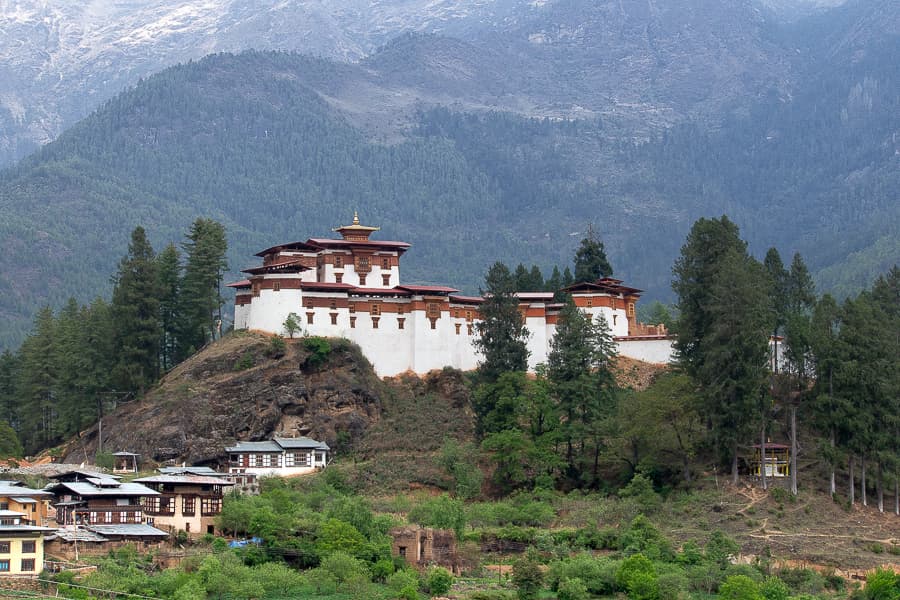
A ruined fortress and a Chomolhari panorama
Drukgyel Dzong sits at the head of the upper Paro valley at 2,500 metres elevation, on a low ridge with an open view north to the snow peak of Chomolhari (7,326 m). Founded in 1649 by Tenzin Drukda to commemorate Bhutan's victory over a Tibetan invasion, the dzong was destroyed by fire in 1951 and stood as a romantic ruin for over six decades. Royal Government restoration commenced in 2016 and is ongoing.
Also known as · Druk Gyel Dzong · Victory Fortress
Drukgyel Dzong was founded in 1649 by Tenzin Drukda, the 3rd Druk Desi (Temporal Ruler), to commemorate Bhutan's victory over a Tibetan invasion ten years earlier. The dzong's name means 'victory of the Drukpa' (Drukpa being the dominant Bhutanese Buddhist lineage). The site selection — at the head of the upper Paro valley, controlling the historical trade route to Tibet through the Tremo La pass — was strategic: any future Tibetan force advancing on Paro would have had to pass beneath the dzong's walls. The dzong served as the principal western military and trade-control fortress for nearly three centuries.
In 1951, a butter lamp in one of the dzong's interior chapels caught the timber framing alight; the fire consumed the dzong within a single night. The Royal Government of the time chose not to rebuild — Bhutan's military function for Drukgyel had long since ceased, and the cost of full reconstruction was prohibitive — and the dzong stood as a romantic ruin for over six decades. The ruined walls, the open stone courtyards, the rusted iron-work — and the open view north to Chomolhari — made Drukgyel one of the most-photographed sites in Bhutan through the late 20th and early 21st centuries. National Geographic's 1914 photograph of the dzong (taken thirty-seven years before the fire) is one of the most-circulated images of pre-modern Bhutan.
In 2016, His Majesty the King commanded the rebuilding of Drukgyel Dzong as part of the celebrations marking the birth of His Royal Highness the Gyalsey (the Crown Prince). The restoration is being carried out using traditional Bhutanese methods — the timber sourced from Royal Government-managed forests, the proportions reconstructed from the 1914 photograph and from on-site archaeological work, the painted woodwork executed by master craftsmen. The restoration is ongoing; the dzong is partially open to visitors during the construction window, with the upper-courtyard reconstruction now complete.
Visiting
Common questions
Partially — the upper courtyard reconstruction is complete and open to visitors. The full restoration is ongoing as of 2026; access varies by construction phase. Your guide will confirm current access on the day.
Yes if the weather is clear — Drukgyel sits on a ridge with an open northern view to Chomolhari (7,326 m), Bhutan's second-highest peak and one of the most-revered. The peak is most reliably visible in the autumn (October–November) and winter (December–February) clear-sky months. May through September often has the peak obscured by monsoon cloud.
Three reasons. First, it was Bhutan's principal military fortress for nearly three centuries (1649–1951). Second, the 1951 fire and the subsequent romantic ruin made it one of the most-photographed sites in Bhutan. Third, the open northern view to Chomolhari is one of the principal Himalayan panoramas accessible by road in the country.
Construction commenced in 2016 under His Majesty the King's command, marking the birth of His Royal Highness the Gyalsey. Restoration is ongoing as of 2026; the work is being done with traditional Bhutanese methods, and the timeline reflects the careful craft involved.
Yes — Drukgyel Dzong, the Tiger's Nest trailhead, and Kyichu Lhakhang are all in the upper Paro valley and combine naturally as a single-day itinerary. Most visitors do the Tiger's Nest hike in the morning, descend for lunch, and visit Kyichu and Drukgyel in the afternoon.
Journeys featuring this site
Journey
A seven-night Bhutan journey in April — cherry blossom and rhododendron on Bhutan, Paro Tshechu if dates align, transparent pricing.
Journey
A nine-night Bhutan photography journey in the spring window — cherry blossom, rhododendron, the Paro Tshechu thongdrel unfurling at dawn at Rinpung Dzong.
Journey
A fourteen-night Bhutan Chomolhari Trek itinerary in the autumn clear-sky window. Five days at altitude, premium lodges either side, named trekking guides.
Five questions. A bespoke draft back within a day or two.