Preparing
LoadingPreparing
Loading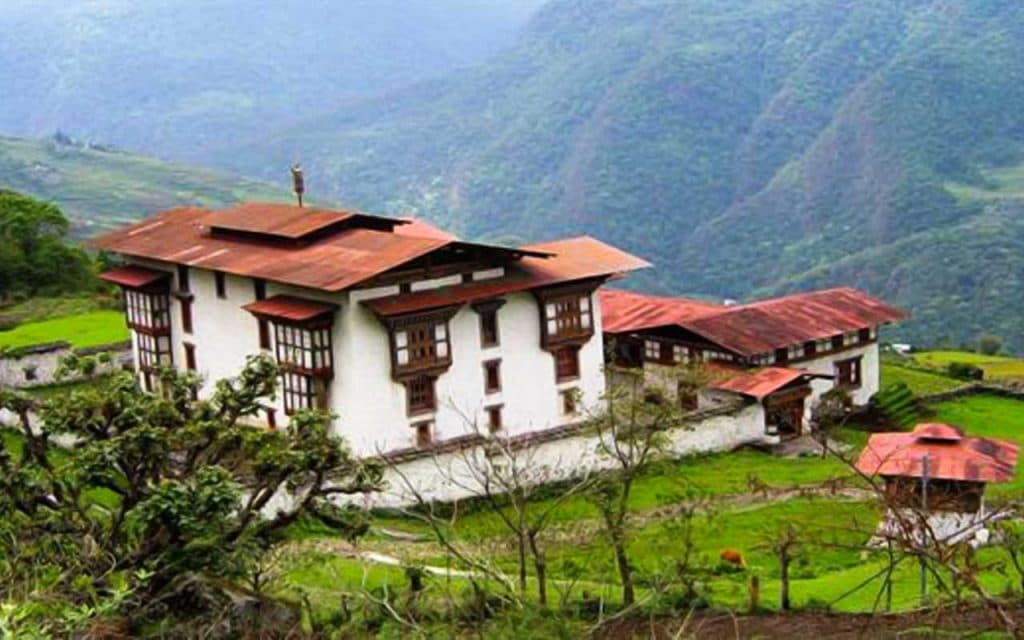
A Bhutanese royal palace
Kuenga Rabten Palace sits at 1,800 metres on a ridge above the Mangde Chhu river, about 23 kilometres south of Trongsa Dzong. Built across the 1930s by His Majesty the Second Druk Gyalpo Jigme Wangchuck as His winter palace — the lower altitude offered a milder cold-season retreat than the higher Bumthang valleys — Kuenga Rabten became His Majesty's favoured residence in the final two decades of His reign. His Majesty passed away at Kuenga Rabten in March 1952. The palace is now a heritage site under conservation by the Department of Culture and one of the more atmospheric historical-palace visits in central Bhutan.
By the late 1920s His Majesty the Second Druk Gyalpo Jigme Wangchuck — who had operated principally from Wangduecholing Palace in Bumthang across the opening decade of His reign — sought a winter palace at a lower altitude than the Bumthang valleys (which sit at 2,600-2,900 metres and are bitterly cold across the December-February period). The choice fell on a ridge above the Mangde Chhu river at 1,800 metres, twenty-three kilometres south of Trongsa Dzong. Construction proceeded across the 1930s; Kuenga Rabten — meaning 'palace of consummate joy' — was largely complete by the late 1930s and became the principal Bhutanese winter royal residence across the subsequent decade and a half. The siting is exceptional: the palace looks out over the Mangde Chhu gorge with the surrounding ridges visible to the north and south.
Across the 1940s and into the early 1950s, Kuenga Rabten became His Majesty's favoured personal residence. The winter atmosphere — milder than Bumthang, more sheltered than Punakha, with the river-and-ridge landscape that the period photographs convey — suited the introspective, deeply religious register that His Majesty's later reign carried. Important state papers were issued from Kuenga Rabten across this period; the principal Trongsa Penlop and Paro Penlop visits to the King were undertaken at Kuenga Rabten; the royal-family residential life — including the upbringing of Crown Prince Jigme Dorji Wangchuck across His teenage years — was anchored at the palace. His Majesty's birthday celebrations were typically held at Kuenga Rabten across the period.
His Majesty the Second Druk Gyalpo Jigme Wangchuck passed away at Kuenga Rabten Palace in March 1952, in the third decade of His reign. The succession had been long-prepared — Crown Prince Jigme Dorji Wangchuck had been the designated successor across the preceding two decades and assumed the throne immediately. The royal-funeral observances at Kuenga Rabten in March 1952 were one of the principal state observances of the period; the body was subsequently transferred to the cremation register at Kurjey Lhakhang in Bumthang per the dynastic tradition. The Kuenga Rabten passing marked the close of the second generation of the Wangchuck dynasty and the opening of the modernisation era under His Majesty the Third Druk Gyalpo.
Kuenga Rabten operates today as a heritage site under careful conservation by the Department of Culture. The palace structure, the courtyards, the surrounding grounds, and the river-and-ridge landscape are preserved as a national heritage asset. Visitors who undertake the Trongsa-anchor visit can include Kuenga Rabten as a half-day excursion from Trongsa town; the matched guide arranges the visit as part of the broader Trongsa cultural programme. The Royal Heritage Museum at Trongsa Ta Dzong has rich interpretive materials on the Kuenga Rabten period for visitors who want to supplement the on-site visit with the broader dynastic narrative.
Also known as · Kuenga Rabten Phodrang · Kuenga Rabten
Visiting
Common questions
The 1,800-metre altitude is deliberately low for a Bhutanese royal residence — well below the 2,700-metre Wangduecholing in Bumthang, the 2,600-metre Punakha Dzong, the 2,300-metre Tashichho Dzong. The choice reflected His Majesty the Second Druk Gyalpo's preference for a milder winter climate; the lower altitude meant Kuenga Rabten was usable across the December-February period without the deep cold of the higher valleys. The river-and-gorge siting also offered atmospheric and visual qualities that the higher-altitude palaces could not match.
For visitors with interest in the Wangchuck-dynastic-residential register, yes — Kuenga Rabten carries the principal His-Majesty-the-Second-Druk-Gyalpo register alongside Wangduecholing in Bumthang, and the on-site atmosphere is exceptional. For general cultural visitors with limited time, the half-day excursion from Trongsa is a real commitment; the matched guide briefs honestly on the trade-off. Visitors taking the longer 7-10 night itineraries with the Trongsa-anchor day can comfortably include Kuenga Rabten without compressing the rest of the day.
Partially. Across the early years of His reign His Majesty the Third Druk Gyalpo Jigme Dorji Wangchuck used Kuenga Rabten on occasional visits — particularly during the principal religious-and-family observances. As His Majesty's reign progressed and the Bhutanese state moved increasingly to the Thimphu anchor (the 1952-onward shift of the capital, the founding of the Tshogdu in 1953, the modernisation arc launching with the 1961 First Five-Year Plan), Kuenga Rabten became less central to the royal-family residential pattern. The palace transitioned to its contemporary heritage-site status across the 1960s and 1970s.
Five questions. A bespoke draft back within a day or two.